What If Coincidence Is Trying to Tell You Something?
In 1949, Carl Jung was sitting with a patient who was recounting a dream in which she had been given a piece of gold jewelry in the shape of a scarab beetle. As she spoke, Jung heard a tapping at the window behind him. He turned to find a scarabaeid beetle — the closest European equivalent to the Egyptian scarab — knocking against the glass. He opened the window, caught it, and handed it to his patient. It was one of the most remarkable synchronicities he had ever witnessed, and one that broke through what he described as his patient's defensive rationalism in a single moment.
But perhaps the synchronicity that shaped Jung's entire intellectual life was quieter and more personal.
In 1928, Jung was deep in the interior work that would become The Red Book — painting a castle-like mandala that felt central to something he couldn't yet name. At that same moment, entirely unsolicited, a manuscript arrived from his friend and fellow scholar Richard Wilhelm, a German sinologist living in China. Wilhelm was asking Jung to write a commentary on his translation of an ancient Taoist alchemical text called The Secret of the Golden Flower. Jung opened it and found, on the frontispiece, a mandala that bore a striking resemblance to the one he had just been painting thousands of miles away.
He stopped work on The Red Book. The coincidence felt like a signal — an outer event mirroring an inner state with an exactness that defied explanation. It was, by his own account, a turning point. And it was out of this moment, and others like it, that Jung began to formulate what he would call synchronicity — the principle that inner and outer worlds are not as separate as they appear.
Jung spent the next two decades developing this idea — ultimately publishing his landmark work Synchronicity: An Acausal Connecting Principle in 1952. But the concept had been alive in him long before that. It grew from moments exactly like these.
Late in his life Jung reflected on what these experiences had led him to believe about the nature of reality itself. In his Collected Works he wrote that since psyche and matter exist in the same world and rest on the same transcendental foundations, it is not only possible but fairly probable that psyche and matter are two different aspects of one and the same thing. Synchronicity, he felt, pointed precisely in this direction.
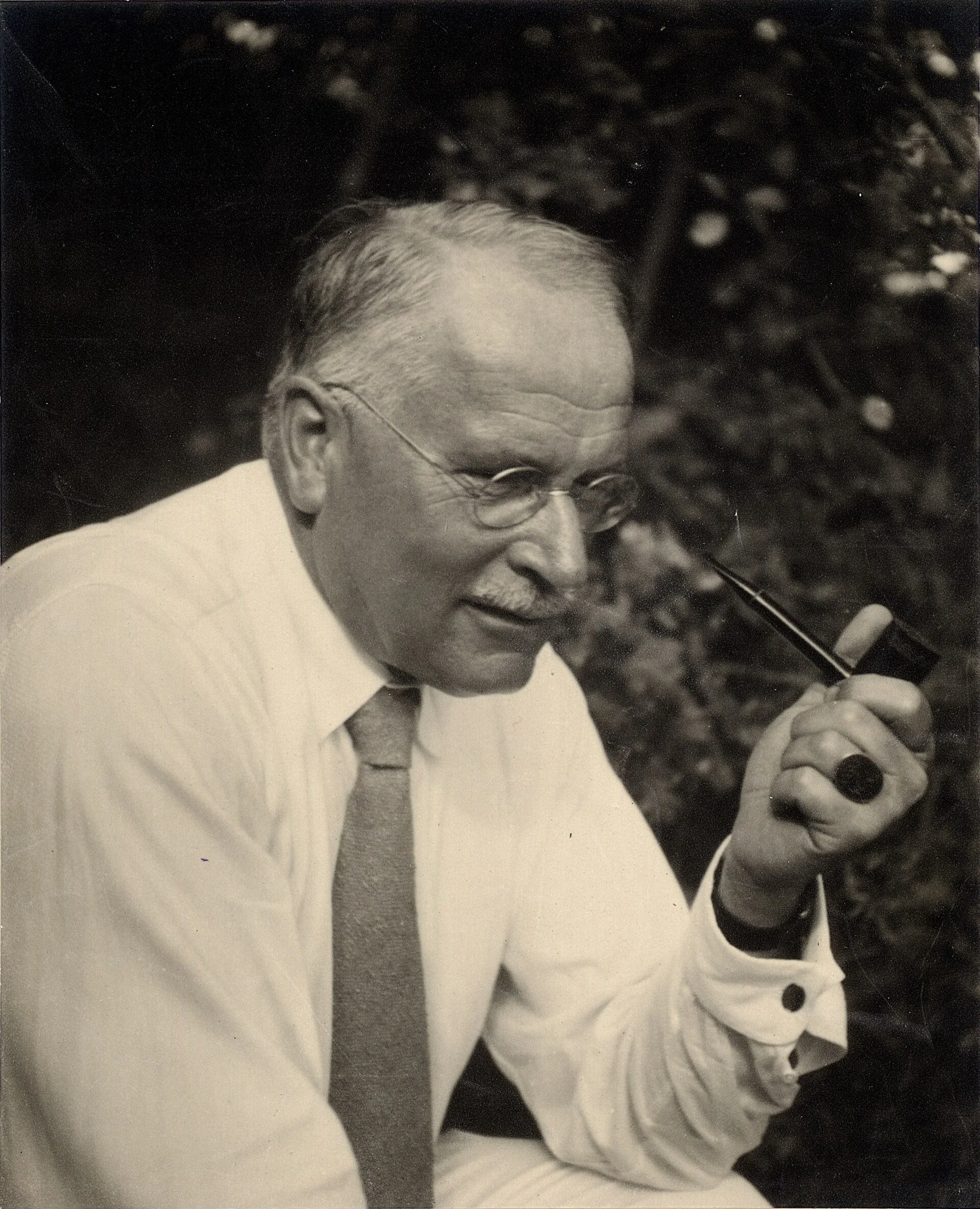
Carl Jung, depth psychologist & founder of analytical psychology
The Question Worth Sitting With
Most of us have had experiences we couldn't quite explain. You think of someone you haven't spoken to in years and they call that afternoon. You are wrestling with a decision and a stranger's offhand comment speaks directly to what you've been turning over in your mind. You keep encountering the same word, image, or idea in unrelated places until it becomes impossible to ignore.
We tend to dismiss these moments. We call them coincidence and move on. But what if the dismissal is the mistake?
As a depth psychologist, I have spent years sitting with people in these moments — the ones that resist easy explanation but carry an unmistakable weight. What I've come to understand is that these experiences are not anomalies. They are the psyche communicating what the conscious mind hasn't yet caught up with. And they are almost always worth pausing for.
Intuition Works the Same Way
Synchronicity has an interior counterpart — intuition. Where synchronicity shows up in the world around us, intuition arises from within. It is that quiet knowing, the pause before sending an email, the sense that something is off before you can articulate why, the pull toward a decision that logic alone wouldn't justify.
Jung considered intuition one of the four primary functions of consciousness — not a soft, unreliable feeling but a legitimate mode of perception. In yoga philosophy it is called pratibha — direct insight that arises when the mind is still enough to receive it.
Together, intuition and synchronicity form a kind of dialogue between inner and outer worlds. When we learn to participate in that dialogue consciously, something shifts. We move through life with a different quality of attention — less reactive, more attuned, more awake to what is actually unfolding.
This Is a Practice, Not a Belief System
You don't have to adopt any particular worldview to begin working with these experiences. You simply have to be willing to notice. To pause when something feels significant. To ask what a recurring pattern might be pointing toward. To trust, even provisionally, that your inner knowing is worth listening to.
These are learnable skills. They deepen with practice and with the right kind of reflection.

What If Synchronicity Isn't the Exception but the Rule?
Jung himself speculated toward the end of his life that if the relationship between body and soul proved to be synchronistic, he would have to revise his view of synchronicity as a relatively rare phenomenon.
From the perspective of nondual yoga philosophy — and increasingly from the frontier of quantum physics and holographic models of reality — this revision may be exactly what is called for. What we call synchronicity may not be an interruption of ordinary life but a glimpse behind it, a momentary clearing of the interference patterns that ordinarily obscure our perception of an underlying wholeness. The question is not whether these connections exist. The question is whether we have developed the inner optics to see them.
An Invitation
I've put together a free guide, Exploring Intuition and Synchronicity: A Path to Deeper Connection, that brings together frameworks from depth psychology, yoga philosophy, and consciousness studies alongside practical tools for developing a more conscious relationship with your own intuition.
It includes journaling prompts, mindfulness exercises, and a curated reading list. It is designed to be returned to rather than read once and set aside.
If you have had moments you couldn't explain but couldn't quite dismiss either, this guide is for you.
I also teach a year-long Transformational Coaching Certification with Shilah Sarkissian through Center for Transformation and Integration, for therapists, coaches, yoga teachers, bodyworkers, and contemplatives who have reached the edge of what their original discipline alone can offer.