No Kings: Reclaiming the Sacred Balance of Power
A Jungian reflection on power, archetype, and the sacred task of restoring balance — within the psyche and the world.
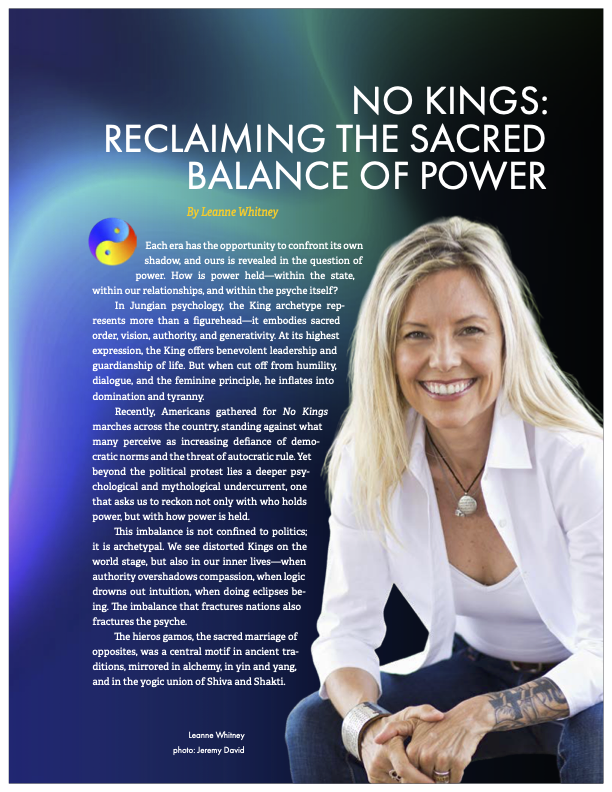
Moments of cultural upheaval often invite deeper reflection — not only about what is happening in the world, but about the archetypal forces shaping our collective experience.
The recent “No Kings” movement sparked wide discussion around leadership and power. Yet beyond political interpretation lies a deeper psychological question: what happens when power becomes unbalanced, whether in society or within the psyche?
In a recent issue of New Thinking Allowed Magazine, I explored this question through a Jungian lens — viewing the movement not only as a cultural event, but as a symbolic invitation toward integration and the restoration of balance.
Below is the full article as originally published.
Originally published in New Thinking Allowed Magazine — Issue 09
Each era has the opportunity to confront its own shadow, and ours is revealed in the question of power. How is power held—within the state, within our relationships, and within the psyche itself?
In Jungian psychology, the King archetype represents more than a figurehead—it embodies sacred order, vision, authority, and generativity. At its highest expression, the King offers benevolent leadership and guardianship of life. But when cut off from humility, dialogue, and the feminine principle, he inflates into domination and tyranny.
Recently, Americans gathered for No Kings marches across the country, standing against what many perceive as increasing defiance of democratic norms and the threat of autocratic rule. Yet beyond the political protest lies a deeper psychological and mythological undercurrent, one that asks us to reckon not only with who holds power, but with how power is held.
This imbalance is not confined to politics; it is archetypal. We see distorted Kings on the world stage, but also in our inner lives—when authority overshadows compassion, when logic drowns out intuition, when doing eclipses being. The imbalance that fractures nations also fractures the psyche.
The hieros gamos, the sacred marriage of opposites, was a central motif in ancient traditions, mirrored in alchemy, in yin and yang, and in the yogic union of Shiva and Shakti.
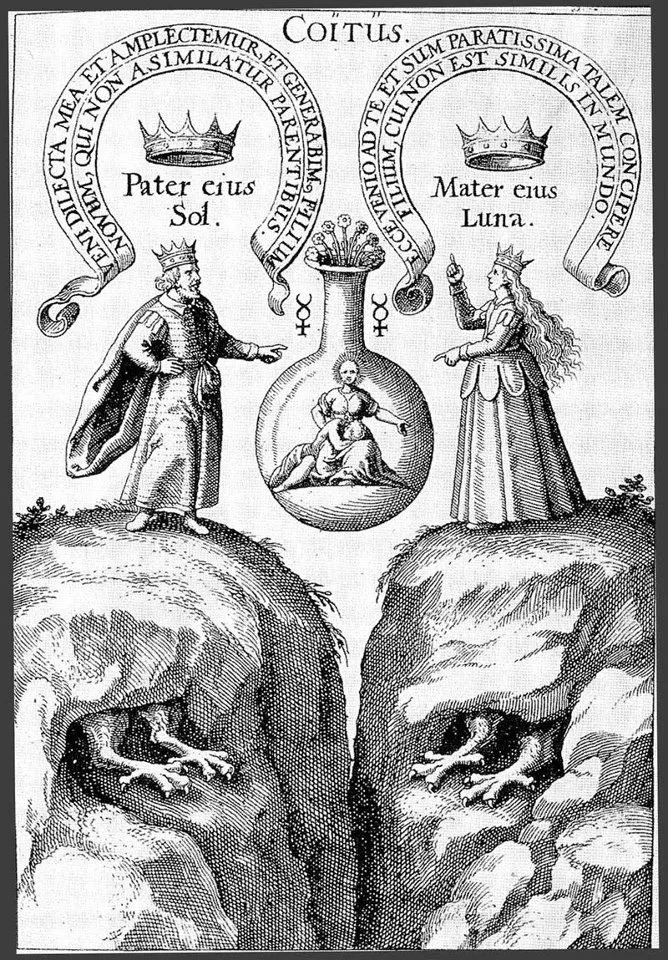
Alchemical engraving depicting the process
of transformation, from Johann Daniel Mylius’
seminal work Anatomia Auri, published in 1628.
In Jungian psychology, it represents the essential task of individuation: integrating the masculine and feminine energies within ourselves to become whole. Without this inner marriage, the King archetype rules without humility, dialogue, or soul.
Seen this way, the cry of No Kings becomes more than a rejection of autocracy. It is a call to integration. It reminds us that the overreach of any single voice, any inflated ego, or any one-sided ideology is unsustainable. Like the psyche itself, democracy depends on dialogue, balance, and relationship.
The deeper journey we are collectively being called to take is not conquest, but return: return to the feminine, to the Earth, to the soul. To the Queen within and among us. Without this return, there is no true King, only the mask of power concealing fear.
To be clear, this is not only a cultural crisis but a personal one. Jungian psychology reminds us that the seeds of shadow exist in all of us: the urge to project, to split, to seek a savior—or to become one. The task is to recognize these patterns and rise into integration.
The No Kings movement can therefore be seen as ritual, a symbolic act in which we begin to withdraw our unconscious investment in distorted power structures and reclaim our own inner sovereignty. A moment to turn inward and ask: Where have I abdicated my authority? Where have I internalized the tyrant or the submissive subject?
What would it mean to live as one who is both King and Queen—grounded in vision, guided by empathy?
Real change will not come from the top down alone. It will come from the inside out: from individuals no longer willing to live in fragmentation, but who commit to the inner work of integration and the outer work of justice.
In the end, it cannot be emphasized enough that the cry of No Kings is not only political but archetypal. It is the psyche’s reminder that wholeness depends on balance—King and Queen, vision and humility, action and care. What we are resisting is not just the rise of autocracy, but the inflation of one-sided power wherever it appears, inside or out.
We are, as a culture, in a rite of passage. The symbolic King is dying, and with him, the illusion of separation. What is being born is something more complex, more communal, more whole.
Let us move forward, then, not only by marching with resistance in our hearts, but with reverence. Not just to topple a false throne, but to remember the sacred balance that makes true leadership possible.
Because in the end, it is not about No Kings or One King. It is about many hearts, aligned in truth, walking each other home.
The reflections shared here are part of an ongoing dialogue taking place within the New Thinking Allowed community, where psychology, spirituality, and consciousness studies meet in meaningful conversation. If you feel drawn to this kind of inquiry, I invite you to explore the magazine and join the wider community engaging these questions with curiosity and depth.
Continue the Conversation
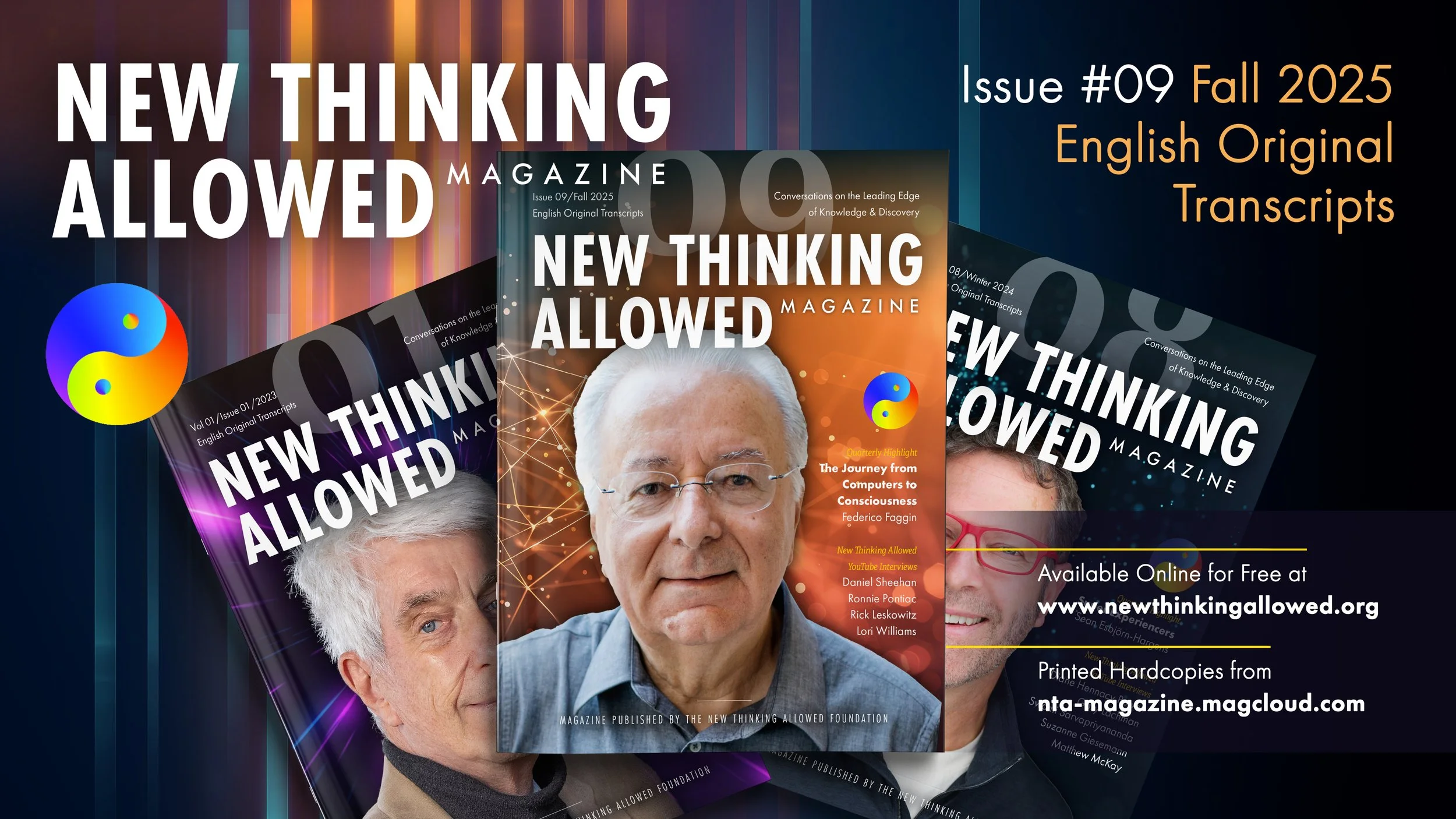
New Thinking Allowed Magazine is a quarterly publication exploring psychology, consciousness, and the leading edge of human inquiry.
Additionally, if this work resonates with you — the Transformational Coaching Certification offers a year-long immersive path into depth psychology, somatic integration, and transformational practice. Begins September 19, 2026. Learn more